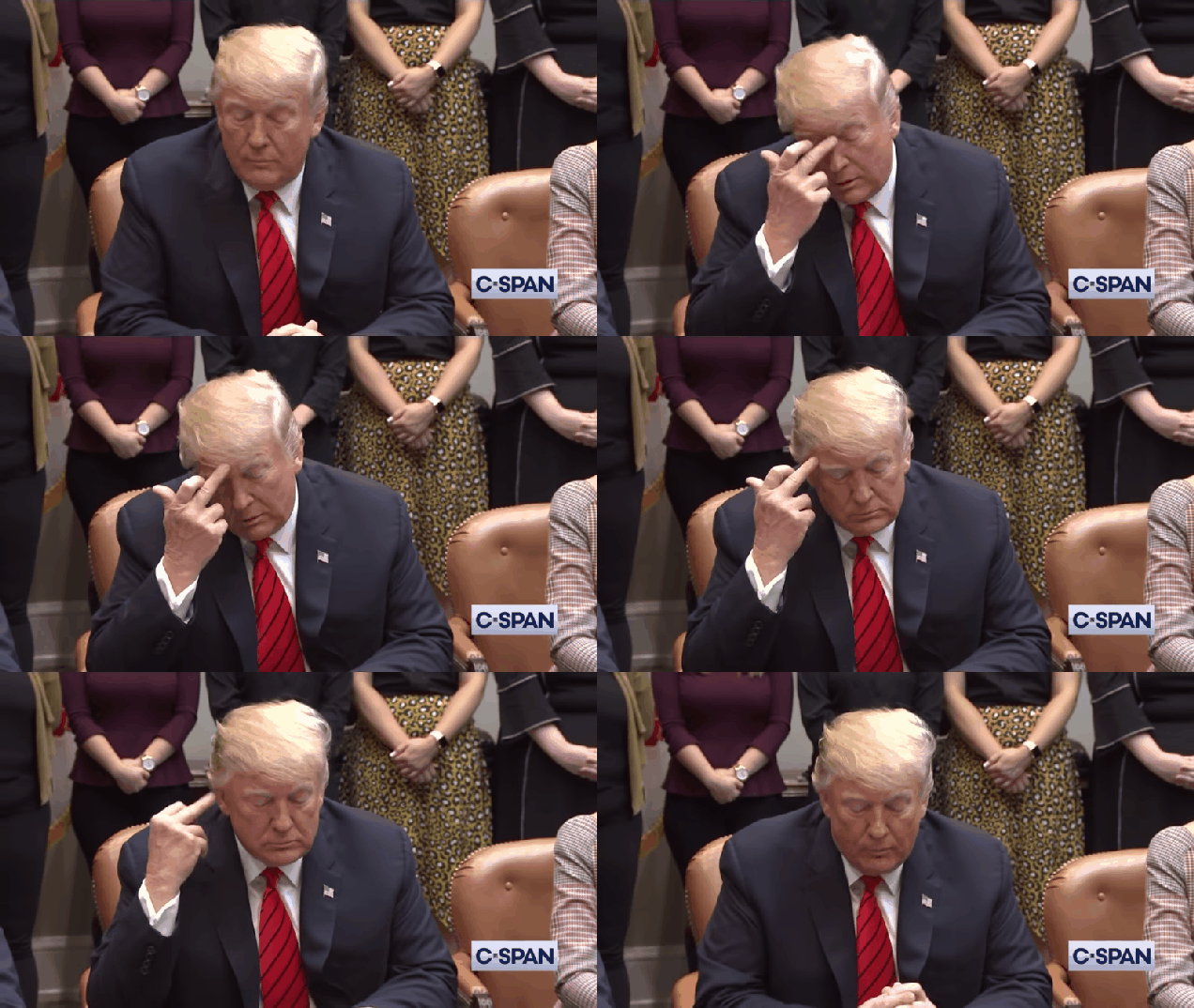
Video of President Donald Trump flashing his middle finger went viral over the weekend. Did the president intentionally flip the bird to women astronauts who corrected one of his factual inaccuracies? That’s open to interpretation. But it’s at least the fourth time during his presidency that Trump appeared to give a…
When Dark Mode was marketed as a headline feature in iOS 13, Apple promoted it as an alternative new look that was easier on the eyes when viewed in dark environments. Oddly though, Apple never mentioned that it also potentially offers energy-saving benefits – particularly for OLED iPhones, since pixels on an OLED panel are individually powered and true black pixels remain inactive.
That potential battery saving has now been put to the test. In an experiment shared on YouTube, PhoneBuff used robotic arms to interact with two fully charged iPhones running iOS 13, with one running in Dark Mode and the other in Light mode. The robots worked their way through various native and third-party apps, all of which support both iOS display modes, until the iPhones died.
The results are pretty conclusive: The test found that an iPhone XS Max using Dark Mode uses up significantly less battery than an iPhone XS using Light Mode. When the Light Mode-enabled iPhone XS died, the Dark Mode iPhone XS still had 30 percent battery life remaining.
PhoneBuff notes one important variable in his test that conditioned the results: The iPhones both had their displays set to 200 nits brightness. At 100 nits, which is what you'd expect indoors, two hours on Twitter saved just 5 percent more battery in Dark Mode. The same test performed at 300 nits, which is closer to outdoors use, saw Dark Mode save 12 percent battery.
Either way, the test appears to prove that Dark Mode is a significant battery saver for OLED iPhones, which include the iPhone X, iPhone XS, and iPhone 11 Pro, but not the iPhone XR or iPhone 11. You can watch the video embedded above for the full lowdown.
Apple has targeted a 2020 release for its augmented reality headset, although the timeframe could be pushed back if the product needs more development, according to Bloomberg's Mark Gurman.
Google Glasses
The report claims the glasses are expected to wirelessly pair with an iPhone to display information such as messages, emails, and maps over the wearer's field of vision. It would also be possible to play games on the headset, with Apple reportedly considering having an App Store for the headset.
Google has said it will release a software update "in the coming months" that will let Pixel 4 owners require their eyes to be open for the phone's Face Unlock security feature to work.
The acknowledgement follows last week's discovery that the Pixel 4's facial authentication system isn't currently capable of distinguishing a face with eyes open versus eyes closed. The finding immediately sparked concerns that the phone could be opened by anyone simply by waving it in front of its sleeping / dead owner.
Google's Pixel 4 Face Unlock feature replaces the fingerprint sensor and works similarly to Apple's Face ID, which is found on iPhones and iPads that have a TrueDepth camera system. However, Face ID requires by default that the user's eyes are open, although users can turn off this Attention Aware option in settings.
Previously, Google said that Face Unlock "is designed to get better over time with future software updates," but stopped short of committing to deliver the "Require eyes to be open" toggle that was spotted in pre-launch leaks of the Pixel 4's features. Now though, it wants customers to know that the setting is on its way. The company gave the following statement (via The Verge):
We've been working on an option for users to require their eyes to be open to unlock the phone, which will be delivered in a software update in the coming months. In the meantime, if any Pixel 4 users are concerned that someone may take their phone and try to unlock it while their eyes are closed, they can activate a security feature that requires a pin, pattern or password for the next unlock.
Despite the security implications of Face Unlock working even if your eyes are closed, Google still claims the feature "meets the security requirements as a strong biometric, and can be used for payments and app authentication, including banking apps. It is resilient against invalid unlock attempts via other means, like with masks."
Google has said it will patch a "bug" in Google Photos that enables iPhone users to store pictures in the cloud in their original quality without counting toward their Google Drive storage limit.
Currently, the Google Photos iOS app happily uploads photos in Apple's efficient HEIC format without requiring them to be converted from "Original Quality" to "High Quality JPEG."
The reason is that the HEIC photos are already smaller than Google's compressed JPEG format, so the Photos app doesn't convert them during upload, meaning the pictures are essentially stored on Google's servers for free in their original size. The quirk was uncovered by a Reddit user last week.
However, the unintentional perk for Apple device owners looks to be on borrowed time. Over the weekend, a Google spokesperson told AndroidPolice: "We are aware of this bug and are working to fix it."
The wording of the statement doesn't exactly make it clear how, though. Google Photos may start converting HEIC photos to the less-efficient High Quality JPEG format during upload, which would result in an additional reduction in quality. Alternatively, Google could allow the pictures to be uploaded as-is but start counting them toward Google Drive usage. We'll have to wait and see which course the search giant takes.
Under Google One plans, Google account holders are entitled to 15GB of free Google Drive cloud storage. Beyond the free allotment, Google charges $1.99 a month for 100GB storage, $2.99 for 200GB a month, and $9.99 a month for 2TB, with additional 10TB and 20TB storage options available.


 Google has said it will patch a "bug" in Google


