Tuesday, 22 October 2019

Arlo Ultra Security Camera and Netatmo Weather Station Now Support HomeKit

Two smart home accessories gained HomeKit support today, including the Arlo Ultra security camera and the Netatmo Weather Station.

Arlo Ultra


While users can already control Arlo Ultra cameras via the Arlo app, HomeKit compatibility enables iPhone, iPad, Mac, and Apple Watch users to control the cameras with Apple's Home app and Siri voice commands. A free-of-charge automatic firmware update is now rolling out for both new and existing Ultra users.

With HomeKit, Arlo Ultra owners will now be able to receive notifications via the Home app when motion is detected. On the iPhone and iPad, users can also use Siri to quickly activate a HD livestream of the camera feed.


HomeKit also allows users to set up automations to control other HomeKit-enabled smart home devices. For example, users can set up an automation to trigger HomeKit-enabled lights to turn on at certain times when motion is detected by an Arlo Ultra camera for added comfort and security.

Arlo Ultra security cameras have a wire-free setup and feature 4K HDR video quality, color night vision, a 180-degree diagonal field-of-view, an integrated spotlight, and two-way audio with advanced noise cancelation.

Pricing starts at $399.99, including a one-year subscription to 30-day rolling storage of cloud recordings.

Netatmo Weather Station


Netatmo has announced that all of its Weather Stations manufactured since October 2016 are now compatible with HomeKit. Older models do not support HomeKit due to necessary hardware changes Netatmo had to make.

To check whether your Weather Station is compatible with HomeKit, open the Netatmo Weather app on an iPhone or iPad and navigate to Settings > Station Name > Indoor Module > Hardware Version within the app. Station V3 models now support HomeKit, while V1 and V2 models do not.


HomeKit support allows Weather Station owners to view the indoor and outdoor humidity and temperature, indoor CO2 level, and indoor air quality in Apple's Home app. Noise, atmospheric pressure, wind, and rain data remains limited to the Netatmo Weather app for now due to HomeKit limitations.

Weather Station users can also ask Siri to read aloud the measurements. Example questions include "Hey Siri, what's the temperature on the balcony?" or "Hey Siri, what's the CO2 level in the living room?"

And with automations, users can trigger various actions, such as HomeKit-enabled lights turning on if indoor CO2 levels become too high. Apple's Home app does not currently allow users to create automations related to temperature and humidity because those metrics are not recognized as triggers.

Weather Station pricing starts at $179.99.


This article, "Arlo Ultra Security Camera and Netatmo Weather Station Now Support HomeKit" first appeared on MacRumors.com

Discuss this article in our forums


from MacRumors: Mac News and Rumors - All Stories https://ift.tt/2JcyRY6

Updates From The Batman, Wonder Woman 1984, and More

Hulu’s putting zombies on a boat. HBO Max wants its own “Victorian X-Files” series. Get a look at the return of Birds of Prey’s Huntress for Crisis on Infinite Earths. Plus, new pictures from Titans, Amazon tackles The Feed, and what’s to come on Watchmen. To me, my spoilers!

Read more...


from Gizmodo https://ift.tt/2p7xm6L

Sphero's New RVR Programmable and Customizable Robot Now Available for Purchase Worldwide

Following a successful debut on Kickstarter, Sphero's newest robot, the RVR, is now available for purchase worldwide.

The RVR is a fully programmable and customizable RC car that's drivable right out of the box, but also built for customization with a wide range of built-in sensors and support for multiple skill levels.


There's a color sensor, a light sensor, infrared, a magnetometer, an accelerometer, and a gyroscope. There's a 4-pin UART expansion port that's able to work with third-party hardware like Raspberry Pi, Arduino, micro:bit, and more, for adding components like robotic arms, camera, and tons more. Sphero's littleBits add-ons are also compatible with the included USB port.

The RVR includes a removable, rechargeable battery in the RVR that also offers enough juice to power third-party hardware, plus it features a high-power motor, all-terrain treads, and enough torque to be able to be driven on rougher terrain.


Sphero says the RVR includes an accurate, professional-level control system that's able to navigate obstacles and uneven surfaces, plus it can interface with other Sphero robots.

Sphero RVR can be purchased from the Sphero website starting today for $250.

Tag: Sphero

This article, "Sphero's New RVR Programmable and Customizable Robot Now Available for Purchase Worldwide" first appeared on MacRumors.com

Discuss this article in our forums


from MacRumors: Mac News and Rumors - All Stories https://ift.tt/33Y7sBj

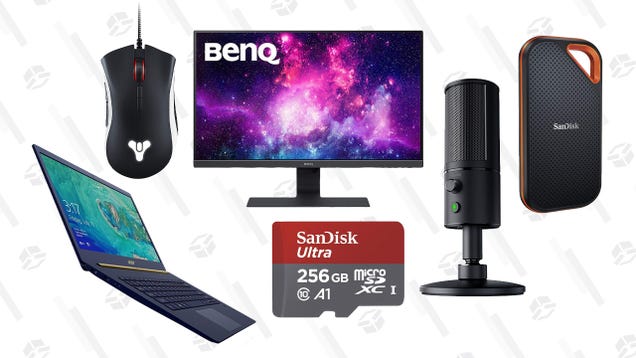
Build, Upgrade, or Augment Your PC With Today's Amazon Gold Box

PC and Accessory Gold Box | Amazon

Read more...


from Gizmodo https://ift.tt/2HHix2C

Sketchy Rumor: Apple's 2020 iPhones to Feature Smaller Notch and Wider Antenna Lines for 5G

Apple is testing different Face ID prototypes that would allow a smaller notch to be used in its 2020 iPhones, according to leaker and concept artist Ben Geskin.

Geskin previously created a rough concept to visualize the alleged 2020 iPhone.

Last month, Geskin claimed Apple has prototyped at least one iPhone with a 6.7-inch display and no notch, housing the TrueDepth sensors for Face ID in the bezel above the display instead. Respected Apple analyst Ming-Chi Kuo has also previously reported that Apple intends to introduce a new form factor, which could potentially include a slimmer bezel.

Ben Geskin now claims various Face ID models are being considered, with prototypes using new optics. Some are said to be smaller in width, while some are narrower to fit the sensors in the top bezel.


Additionally, Geskin claims Apple is revising the antennas on its 2020 iPhones in order to support the forthcoming 5G. Specifically, the prototypes are said to include "wider antenna lines (>1mm) for 5G." These lines will be made of glass, ceramic or sapphire, says Geskin.

Lastly, Geskin reports that Apple eventually wants to do away with the Lightning port and switch to an entirely wireless charging solution, suggesting the company has no plans to adopt USB-C across its iPhones, as some have hoped.

Geskin has shared some accurate information in the past, including details about the iPhone X prior to that device’s release, but his track record is not perfect. This rumor should be treated with skepticism until it is corroborated by other sources.


This article, "Sketchy Rumor: Apple's 2020 iPhones to Feature Smaller Notch and Wider Antenna Lines for 5G" first appeared on MacRumors.com

Discuss this article in our forums


from MacRumors: Mac News and Rumors - All Stories https://ift.tt/2N6wdnO