Monday, 10 August 2020

Apple Countersues US Stereo Headphone Inventor Koss in Response to Patent Lawsuit

Apple is countersuing Stereophone inventor and audio manufacturer Koss over a patent lawsuit it recently filed in Waco, Texas, accusing Apple and several audio companies of violating patents relating to its wireless headphone technology.


In the Koss lawsuit, originally spotted by Patently Apple, AirPods and Beats wireless headphones are accused of violating five patents relating to wireless headphone technology that Koss essentially says it pioneered in the industry. The four patents describe wireless earphones that involve a transceiver circuit, enabling a device to stream audio from a digital audio player, computer, or wireless network.

Koss said Apple was aware of these patents and met several times to discuss using them, before deciding not to license any of the company's technology. Koss now wants an unspecified amount in compensation for the alleged infringements, "which by law cannot be less than a reasonable royalty, together with interests and costs."

In Apple's filing registered with the U.S. District Court for the Northern California on August 8, however, it claims Koss' allegations are "baseless." Moreover, it alleges that the lawsuit also breaks a written confidentiality agreement that Koss demanded and Apple ultimately agreed to in 2017.

According to the agreement, neither Apple nor Koss "would use or attempt to use any Communications [between the parties], or the existence thereof, in a litigation or any other administrative or court proceeding for any purpose."
According to the terms of the Confidentiality Agreement, while the agreement was in force, Apple could not advise a Court of Koss' threats to file baseless infringement claims or ask a Court to declare Apple's rights and resolve the legal uncertainty it faced. The Confidentiality Agreement also restricted how Apple could disclose and use the existence and contents of the discussions. But the agreement also protected Apple—Koss was not permitted to later use the fact that Apple had agreed to a discussion with Koss, or the contents of the discussion, against Apple in litigation.

In other words, having enticed Apple to participate in discussions, reveal information, and forego some of its legal options, Koss could not use Apple's participation against it as a "gotcha" to bring claims in a later litigation.
Apple now says this is precisely what Koss has done in bringing the lawsuit, thereby rendering it invalid. In addition to the alleged breach of contract, Apple also submitted documentary evidence that it says proves that it hasn't violated any of the patents cited by Koss in its original litigation.

Apart from Apple, other companies targeted by the Koss lawsuit include Bose, JLab, Plantronics, and Skullcandy, all of which allegedly violate Koss patents related to in-ear wireless headphones technology that is now used widely in the audio market.
This article, "Apple Countersues US Stereo Headphone Inventor Koss in Response to Patent Lawsuit" first appeared on MacRumors.com

Discuss this article in our forums


from MacRumors: Mac News and Rumors - All Stories https://ift.tt/3acRzLF

TikTok to Sue Trump Administration Over US Ban as Soon As Tuesday

TikTok plans to sue the Trump administration as soon as this week, challenging the president's recent executive order to ban the short-form video sharing platform from the United States.


According to a source who spoke to NPR, TikTok will file a federal lawsuit in the U.S. District Court for Southern California, where its American operations are based, as early as Tuesday.
NPR has learned that the lawsuit will argue that President Trump's far-reaching action is unconstitutional because it failed to give the company a chance to respond. It also alleges that the administration's national security justification for the order is baseless, according to the source.

"It's based on pure speculation and conjecture," the source said. "The order has no findings of fact, just reiterates rhetoric about China that has been kicking around."
White House spokesman Judd Deere declined to comment on the potential lawsuit, and instead defended the executive order. "The Administration is committed to protecting the American people from all cyber related threats to critical infrastructure, public health and safety, and our economic and national security," he said.

Trump on Friday signed two executive orders that would officially ban any U.S. transactions with the Chinese companies that own TikTok and WeChat in 45 days, in an escalation of the ongoing technological cold war between the two countries.

TikTok, which is owned by ByteDance, said it was "shocked" by the executive order and that it would respond in court, if necessary. In a statement, TikTok said, "The text of the decision makes it plain that there has been a reliance on unnamed 'reports' with no citations, fears that the app 'may be' used for misinformation campaigns with no substantiation of such fears, and concerns about the collection of data that is industry standard for thousands of mobile apps around the world."

Microsoft has publicly confirmed its intention to purchase TikTok in the United States within 45 days, and the company is currently in discussions with ByteDance. Twitter has also reportedly expressed interest in acquiring the service. A previous report suggesting Apple is interested in buying the app turned out to be inaccurate.

Note: Due to the political or social nature of the discussion regarding this topic, the discussion thread is located in our Political News forum. All forum members and site visitors are welcome to read and follow the thread, but posting is limited to forum members with at least 100 posts.
Tag: TikTok

This article, "TikTok to Sue Trump Administration Over US Ban as Soon As Tuesday" first appeared on MacRumors.com

Discuss this article in our forums


from MacRumors: Mac News and Rumors - All Stories https://ift.tt/3irrbjX

Apple Watch Likely to Adopt MicroLED Display Technology in 3-4 Years

This year's Apple Watch Series 6 is expected to feature an OLED screen like previous models, but a future model is likely to be the first Apple product to adopt MicroLED display technology, albeit not for another three to four years.


That's the main takeaway reading between the lines of comments made by the chairman of Epistar, Taiwan's top LED producer, which is reportedly working on a factory to manufacture MicroLED displays specifically for future Apple products.

From a DigiTimes' report filed on Monday:
Smartwatches will be the first major applications for micro LED with volume adoption likely to take place 3-4 years from now, according to Epistar chairman Lee Biing-jye.

Epistar has overcome many micro LED technological difficulties, such as mass transfer, and expects to achieve reliable production capability in 2-3 years, and introduce end-market applications in 3-4 years, Lee noted.
Apple is reportedly investing $330 million in the Taiwanese MicroLED factory to manufacture displays for future iPhones, iPads, MacBooks, and other devices. MicroLEDs sized 20-50 microns are too small for PCB substrates that support minimum sizes of 50-100 microns, and therefore glass substrates are used.

Taiwanese LCD panel maker AU Optronics is understood to be supplying the glass substrates for the displays, while Epistar is said to be now focusing on improving yield rates for micro LED epitaxy and reducing cost for mass transfer.

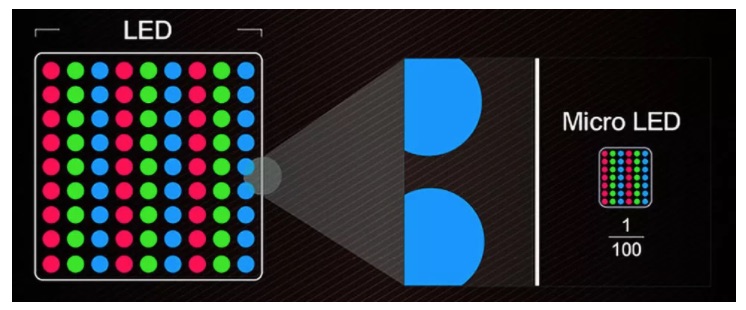
There are several advantages of MicroLED screens over LCD and OLED displays, including being thinner and more energy efficient. For example, the power consumption of MicroLED screens is only one-tenth that of LCD displays, and the color saturation is close to OLED.


In addition, MicroLED can support a higher brightness, higher dynamic range, and wider color gamut, while also achieving a faster update rate, wider viewing angle, and lower power consumption.

Owing to the difficulties involved in developing MicroLED technology, early designs are expected to rely on mini-LEDs that are somewhere in between traditional LED and MicroLED technology. However, Apple still considers MicroLED technology to be the "top priority," according to a previous report.

Apple has six mini-LED products in the works that are set to debut in 2020 and 2021, according to analyst Ming-Chi Kuo. Apple is said to be debuting the technology in a 12.9-inch ‌iPad Pro‌ for launch later this year, followed by a 27-inch iMac Pro, a 14.1-inch MacBook Pro, a 16-inch ‌‌‌‌MacBook Pro‌‌‌‌, a 10.2.-inch iPad, and a 7.9-inch ‌‌‌‌iPad‌‌‌‌ mini.

Apple has reportedly been testing prototype ‌‌‌Apple Watch‌‌‌ models with MicroLED displays since 2017. While early rumors suggested an ‌‌‌Apple Watch‌‌‌ with a microLED display could launch as early as 2020, one leaker poured cold water on that prediction in May by claiming that this year's ‌‌Apple Watch‌‌ Series 6 will use the same OLED display as previous models.

There is precedent for new screen technologies showing up in the ‌‌Apple Watch‌‌ first. When it was introduced in 2014, the ‌‌Apple Watch‌‌ had an OLED screen. The technology then migrated to the ‌iPhone‌ X three years later.
Related Roundups: Apple Watch, watchOS 6, watchOS 7
Buyer's Guide: Apple Watch (Caution)

This article, "Apple Watch Likely to Adopt MicroLED Display Technology in 3-4 Years" first appeared on MacRumors.com

Discuss this article in our forums


from MacRumors: Mac News and Rumors - All Stories https://ift.tt/2PErpYz

Sunday, 9 August 2020

Kuo: Chinese iPhone Shipments Could Decline Up to 30% If Apple Forced to Remove WeChat From Worldwide App Store [Updated]

In a worst-case scenario, Apple's annual iPhone shipments in China could decline by 25–30% if it is forced to remove WeChat from its App Stores around the world, according to a new research note from analyst Ming-Chi Kuo viewed by MacRumors. The removal could occur due to a recent executive order aiming to ban U.S. transactions with WeChat and its parent company Tencent.


Kuo lays out optimistic and pessimistic scenarios depending on whether Apple is only required to remove WeChat from the App Store in the United States or if the ban would apply to the ‌App Store‌ in all countries.

WeChat is extremely popular with Chinese mobile device users, essentially operating as its own platform on top of iOS and Android for many users, and Kuo argues that a worldwide ban on WeChat in the ‌App Store‌ would be devastating due to the size of the Chinese market.
Because WeChat has become a daily necessity in China, integrating functions such as messaging, payment, e-commerce, social networking, news reading, and productivity, if this is the case, we believe that Apple's hardware product shipments in the Chinese market will decline significantly. We estimate that the annual ‌iPhone‌ shipments will be revised down by 25–30%, and the annual shipments of other Apple hardware devices, including AirPods, iPad, Apple Watch and Mac, will be revised down by 15–25%.
Under his optimistic scenario in which WeChat is only removed from the U.S. ‌App Store‌, Kuo predicts ‌iPhone‌ shipments would be impacted by 3–6% with other Apple products being affected by less than 3%.

Apple does not break down its ‌iPhone‌ shipments by region, but overall, Greater China accounted for a little over 15% of Apple's total revenue during the June quarter, making it a significant part of Apple's business.

Kuo recommends that investors reduce their stock holdings of companies in Apple's supply chain such as LG Innotek and Genius Electronic Optical due to the risks of a WeChat ban. It does, however, remain to be seen what will happen as the prohibitions laid out in the executive order do not take effect until September 20. As a result, there is still time for the order to be clarified, modified, or rescinded.

Update 10:36 p.m. This article originally stated that the 30% decline was in reference to Apple's total ‌iPhone‌ shipments, but the research note is not completely clear as to whether it refers to global or Chinese shipments. Given the Chinese share of Apple's overall sales, it seems more likely to be referring to Chinese shipments.

Note: Due to the political or social nature of the discussion regarding this topic, the discussion thread is located in our Political News forum. All forum members and site visitors are welcome to read and follow the thread, but posting is limited to forum members with at least 100 posts.
Related Roundup: iPhone 12

This article, "Kuo: Chinese iPhone Shipments Could Decline Up to 30% If Apple Forced to Remove WeChat From Worldwide App Store [Updated]" first appeared on MacRumors.com

Discuss this article in our forums


from MacRumors: Mac News and Rumors - All Stories https://ift.tt/3gJOchA

Twitter Held 'Preliminary Talks' About Acquiring TikTok's U.S. Operations

Amid an impending ban on U.S. operations of TikTok, Twitter has expressed interest in acquiring the service, according to a new report from The Wall Street Journal.


The report explains that it is not immediately obvious why Twitter is interested in purchasing TikTok, given the cost of acquisition and the need for substantial restructuring. Twitter's comparatively small size would, however, likely please antitrust investigators.

Twitter has a market capitalization of around $30 billion, which is almost as much as the valuation of TikTok's available assets, and would need to raise substantial additional capital. Twitter is therefore thought to be unable to finance a large enough bid to displace Microsoft as the front-runner, particularly before the deadline to complete a sale set out by President Trump.

Private equity company Silver Lake, a major Twitter shareholder, is said to be interested in helping to fund a deal. Twitter declined to comment to The Wall Street Journal.

In spite of the talks, Microsoft is still believed to be the front-runner in negotiations to purchase TikTok. Twitter has apparently made the case that its bid would be preferable to Microsoft's since it would not face any pressure from China since it has no current business in that country, unlike Microsoft.

The discussions between TikTok's Chinese parent company ByteDance and Microsoft are supposed to complete no later than September 15, and negotiations are still preliminary. Microsoft has said that it will not provide a further update until there is a definitive outcome.

Twitter previously acquired the short-form video sharing app "Vine" in 2012, but eventually closed the service four years later. TikTok operates similarly to Vine, and comparisons are often drawn between the services.

President Donald Trump signed two executive orders on Friday that set about banning any U.S. transactions with Chinese tech companies, and expressed his will to ban TikTok if it was not acquired by a U.S. company. TikTok is now reportedly planning to sue the Trump administration as soon as Tuesday, in a direct challenge to the president's executive order.

Note: Due to the political or social nature of the discussion regarding this topic, the discussion thread is located in our Political News forum. All forum members and site visitors are welcome to read and follow the thread, but posting is limited to forum members with at least 100 posts.
This article, "Twitter Held 'Preliminary Talks' About Acquiring TikTok's U.S. Operations" first appeared on MacRumors.com

Discuss this article in our forums


from MacRumors: Mac News and Rumors - All Stories https://ift.tt/2PGm0Aq