Friday, 19 June 2020

Pixelmator Photo 1.3 Brings Batch Editing, Shortcut Menus, and More

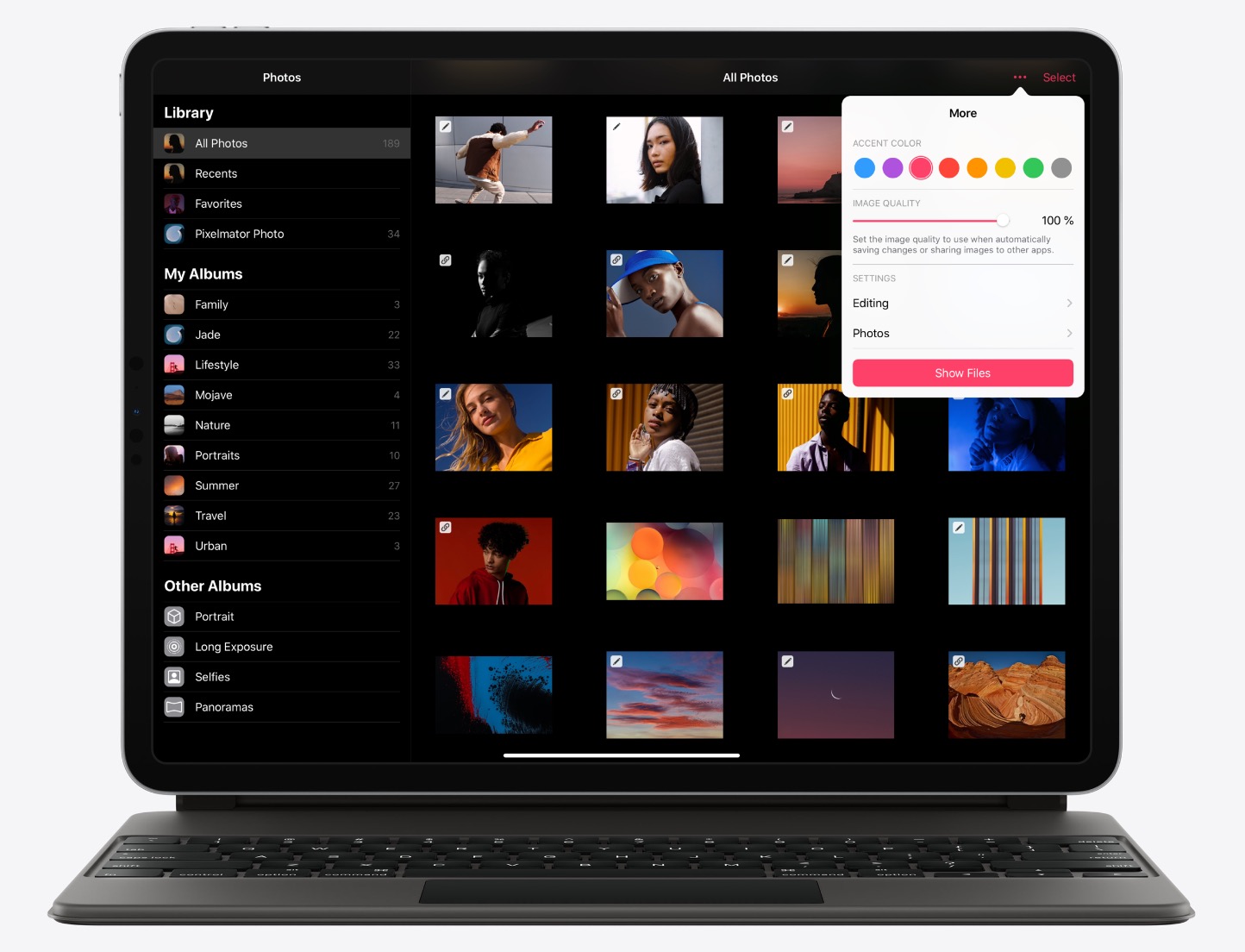
Pixelmator Photo for iPad was updated today to version 1.3, bringing new shortcut menus, customizable accent colors, and batch photo editing improvements to the app.


The new shortcut menus are activated using the touch and hold gesture, and add several functions that aim to make Pixelmator Photo more powerful.

When touching and holding a photo in the Photos library browser, for example, users can quickly share, favorite, duplicate, revert, or delete photos.

The new shortcut menus also allow users to copy and paste adjustments or apply batch workflows from the ‌Photos‌ or Files browsers.

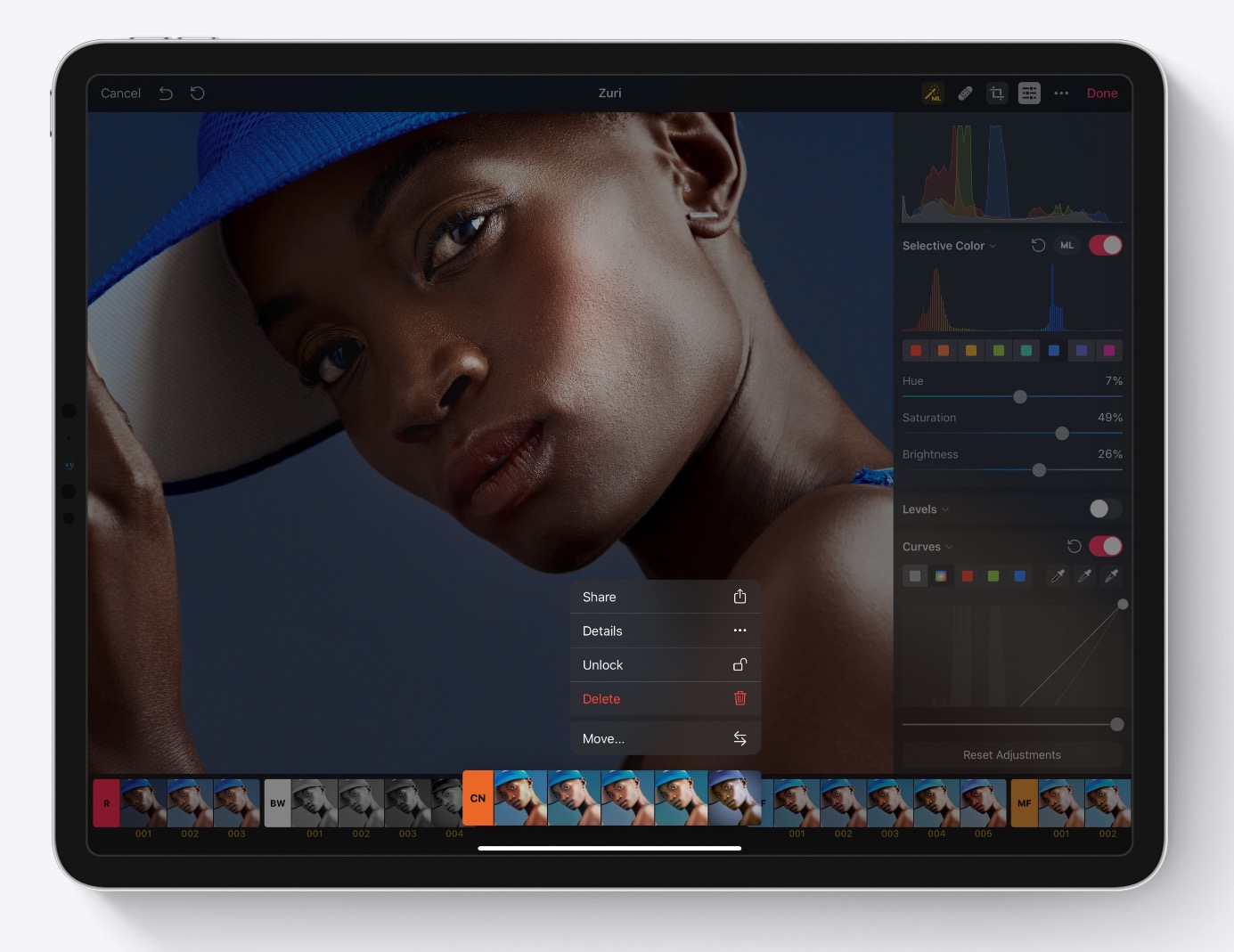
Meanwhile, there are improvements to color adjustment present management, allowing users to create custom color adjustment preset collections and rearrange and remove them for a more personalized editing experience.


Elsewhere, Pixelmator Photo 1.3 includes a new Accent Color feature that lets users customize the color of buttons and other elements in the app. Batch editing has also been improved with a way to mark workflows as favorites and apply them in the ‌Photos‌ or Files browser.

Pixelmator Photo is available to download from the App Store [Direct Link] as a free update for existing users or for $4.99 for new customers.
This article, "Pixelmator Photo 1.3 Brings Batch Editing, Shortcut Menus, and More" first appeared on MacRumors.com

Discuss this article in our forums


from MacRumors: Mac News and Rumors - All Stories https://ift.tt/3hHgH0c

Bloomberg: Apple's AR/VR Gaming Headset Plans Altered By Internal Divisions

Bloomberg's Mark Gurman this morning filed a story detailing the internal divisions at Apple that led it to change the course of its AR and VR headset development.


Specifically, the report covers disagreements between former Apple design chief Jony Ive and Mike Rockwell, the executive heading up Apple's secretive 1,000-strong group devoted to VR and AR, regarding fundamental aspects of the headset, codenamed N301.
N301 was initially designed to be an ultra-powerful system, with graphics and processing speeds previously unheard of for a wearable product. The processing capabilities were so advanced—and produced so much heat—that the technology couldn’t be crammed into a sleek headset. Instead, Rockwell’s team planned to sell a stationary hub, which in prototype form resembled a small Mac, that would connect to the headset with a wireless signal. In Rockwell’s early version, the headset would also be able to operate in a less-powerful independent mode.

Ive balked at the prospect of selling a headset that would require a separate, stationary device for full functionality. He encouraged Rockwell and his team to redevelop N301 around the less powerful technology that could be embedded entirely in the device. Rockwell pushed back, arguing that a wireless hub would enable performance so superior that it would blow anything else on the market out of the water. The standoff lasted for months.
According to the report, Apple CEO Tim Cook ultimately sided with Ive, who didn't want Apple promoting technology that would take people out of the real world. As a result, the headset no longer communicates with a separate hub, making graphics unlikely to be as good as they might have been, and download speeds potentially slower.
Although the headset now in development is less technologically ambitious than originally intended, it's pretty advanced. It's designed to feature ultra-high-resolution screens that will make it almost impossible for a user to differentiate the virtual world from the real one. A cinematic speaker system will make the experience even more realistic, people who have used prototypes say.
Prototypes of the N301 are said to look like a smaller Oculus Quest, Facebook's VR headset, with a mostly fabric body but less plastic than the Quest. Apple's engineering teams are reportedly still testing the device on different head shapes to find the ideal fit, and the company hasn't settled on pricing.

Apple wants the headset to have its own App Store "with a focus on gaming and the ability to stream video content, while also serving as a sort of super-high-tech communications device for virtual meetings." Siri will control the headset, although it is also reportedly being tested with a physical remote.

The N301 headset appears to be only one of Apple's ongoing AR/VR projects. The other is said to be a pair of AR glasses codenamed N421, with current prototypes said to resemble high-priced sunglasses with "thick frames that house the battery and chips." Ive, who left Apple last year after almost three decades at the company, is said to have preferred the concept of the N421 glasses.

Apple's augmented reality headset is expected to be released in 2022 followed by the sleeker pair of augmented reality glasses coming in 2023. You can read the full Bloomberg report here, and for everything we know on Apple's AR/VR plans, be sure to check our dedicated roundup.
Related Roundup: Apple Glasses

This article, "Bloomberg: Apple's AR/VR Gaming Headset Plans Altered By Internal Divisions" first appeared on MacRumors.com

Discuss this article in our forums


from MacRumors: Mac News and Rumors - All Stories https://ift.tt/37KDgwh
Zoom Now Says End-to-End Encryption Will Be Available for All Users

In a U-turn by the popular videoconferencing platform, Zoom this week announced it will make end-to-end encryption available to all users, both paid and unpaid.

...we have identified a path forward that balances the legitimate right of all users to privacy and the safety of users on our platform. This will enable us to offer E2EE as an advanced add-on feature for all of our users around the globe -- free and paid -- while maintaining the ability to prevent and fight abuse on our platform.

To make this possible, Free/Basic users seeking access to E2EE will participate in a one-time process that will prompt the user for additional pieces of information, such as verifying a phone number via a text message. Many leading companies perform similar steps on account creation to reduce the mass creation of abusive accounts. We are confident that by implementing risk-based authentication, in combination with our current mix of tools -- including our Report a User function -- we can continue to prevent and fight abuse.
End-to-end encryption ensures no one but the participants and their devices can see and hear what is happening in a meeting, although it will exclude people who call in to Zoom meetings from a telephone line.

Zoom has attracted millions of free and paying customers amid the global health crisis, with stay-at-home measures causing a surge in the number of people working remotely.

Zoom originally said its initial decision to offer full encryption to premium users only had been based on "a combination of technological, safety and business factors," however in this case it appears as though public pressure won out and led the company to reconsider.

Apple already uses end-to-end encryption to protect FaceTime users as call data travels between two or more devices. Even Apple can't decrypt the call and listen in to user's conversations.
This article, "Zoom Now Says End-to-End Encryption Will Be Available for All Users" first appeared on MacRumors.com

Discuss this article in our forums


from MacRumors: Mac News and Rumors - All Stories https://ift.tt/3fDCILv

Russia Ends Ineffective Ban on Telegram Encrypted Messaging App

Russia this week lifted a nearly two-year ban on messenger app Telegram after it failed to prevent the encrypted platform from being widely used, reports Reuters.


Some Russian media portrayed the move as a capitulation, but the country's media regulator Roskomnadzor said the company had shown "willingness" to help with counterterrorism efforts.
"Roskomnadzor is dropping its demands to restrict access to Telegram messenger in agreement with Russia’s general prosecutor's office," it said in a statement.
The Telegram platform allows people to communicate with each other using end-to-end encryption, meaning no-one – not even Telegram – has access to messages sent between users.

In April 2018, Roskomnadzor began legal proceedings to block the app in the country, after Dubai-based Telegram refused to comply with requests that it hand over the encryption keys that would allow it to access users' data.

But despite blocking IP addresses and VPN services that Telegram may have used to hide traffic, the ensuing ban was largely ineffective.

Telegram CEO Pavel Durov said at the time that his company had chosen to do the "only possible thing" and refused to provide Russia with decryption keys to access user messages, "preserving the right of our users privacy in a troubled country."

Telegram has over 200 million users globally. They have included Kremlin staff, who used Telegram to coordinate conference calls with Vladimir Putin's spokesman. Many government officials also use the messenger app to communicate with media.
This article, "Russia Ends Ineffective Ban on Telegram Encrypted Messaging App" first appeared on MacRumors.com

Discuss this article in our forums


from MacRumors: Mac News and Rumors - All Stories https://ift.tt/2YfcBVB

Apple Doubles Down on 'Hey' App Rejection, No Rule Changes Imminent


Apple SVP Phil Schiller has doubled down on the company's rejection of the 'Hey' email app and says no App Store rule changes are imminent. This despite increasing pressure from developers and regulators who say the company is acting like a monopolist and bully.

“Sitting here today, there’s not any changes to the rules that we are considering,” Schiller said during a call with TechCrunch. “There are many things that they could do to make the app work within the rules that we have. We would love for them to do that.”

The 'Hey' email app from Basecamp requires a subscription to use. In order to circumvent giving Apple a 30% cut of its revenues, Basecamp sold subscriptions outside of the app taking care not to link them or mention them in the app. Even so, Apple says the company must offer its subscription as in-app purchase or face removal from the App Store.


Spotlight Deal:
New MacBook Air On Sale for $899! [Deal]

Share Article:
Facebook,  Twitter,  LinkedIn,  Email,  Reddit,  Digg,  Delicious,  StumbleUpon

Follow iClarified:
Facebook,  Twitter,  LinkedIn,  Newsletter,  App Store,  YouTube


from iClarified - Apple News and Tutorials https://ift.tt/2V22qlc